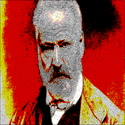
Victor Hugo
Full Name and Common Aliases
Victor Marie Hugo, commonly known simply as Victor Hugo, was a towering figure in French literature. His name is synonymous with the Romantic movement, and he is often referred to as the "Shakespeare of the novel" due to his profound impact on literature and culture.
Birth and Death Dates
Victor Hugo was born on February 26, 1802, in Besançon, France, and he passed away on May 22, 1885, in Paris, France. His life spanned a period of significant political and social change in France, which deeply influenced his work.
Nationality and Profession(s)
Victor Hugo was a French national. He was a prolific writer, poet, playwright, and novelist. In addition to his literary pursuits, Hugo was also a passionate political activist and statesman, using his voice to champion social justice and human rights.
Early Life and Background
Victor Hugo was born into a family with a military background. His father, Léopold Hugo, was a general in Napoleon's army, which meant that the family moved frequently during Hugo's early years. This itinerant lifestyle exposed Hugo to various cultures and landscapes, which would later influence his writing. Despite the instability, Hugo's mother, Sophie Trébuchet, ensured that he received a solid education. From a young age, Hugo showed a keen interest in literature, writing his first plays and poems as a teenager. His early exposure to the political and social upheavals of the time would later inform his passionate advocacy for social reform.
Major Accomplishments
Victor Hugo's career was marked by a series of remarkable accomplishments. He was a leading figure in the Romantic literary movement, which sought to break away from the strictures of classical forms and embrace emotion and individualism. Hugo's work was characterized by its vivid imagery, emotional depth, and exploration of themes such as justice, love, and the human condition. In addition to his literary achievements, Hugo was an influential political figure. He served as a member of the French National Assembly and was a vocal critic of the Second Empire under Napoleon III. His political activism led to his exile from France, during which he continued to write and advocate for social change.
Notable Works or Actions
Victor Hugo's literary output was vast and varied, but he is perhaps best known for his novels "Les Misérables" and "The Hunchback of Notre-Dame". "Les Misérables," published in 1862, is a sweeping epic that explores themes of justice, redemption, and the struggle for social equality. It has been adapted into numerous films, musicals, and plays, cementing its place in popular culture. "The Hunchback of Notre-Dame," published in 1831, is a poignant tale of love and tragedy set against the backdrop of medieval Paris. Hugo's poetry collections, such as "Les Contemplations" and "La Légende des siècles," are also celebrated for their lyrical beauty and philosophical depth.
Impact and Legacy
Victor Hugo's impact on literature and society is immeasurable. His works have been translated into countless languages and continue to resonate with readers around the world. Hugo's exploration of social justice and human rights has inspired generations of activists and reformers. His advocacy for the abolition of the death penalty and his support for the poor and disenfranchised were ahead of his time and remain relevant today. Hugo's influence extends beyond literature; he is remembered as a symbol of resistance against tyranny and a champion of the oppressed.
Why They Are Widely Quoted or Remembered
Victor Hugo is widely quoted and remembered for his profound insights into the human condition and his eloquent expression of universal themes. His ability to capture the complexities of love, justice, and redemption in his writing has made his works timeless. Quotes from Hugo's novels and speeches often reflect his deep empathy for humanity and his unwavering belief in the power of change. His words continue to inspire and challenge readers, encouraging them to reflect on their own values and the society in which they live. Hugo's legacy as a literary giant and a voice for social justice ensures that he remains a relevant and revered figure in both literature and history.
Quotes by Victor Hugo
Victor Hugo's insights on:
England has two books, the Bible and Shakespeare. England made Shakespeare, but the Bible made England.
But listen, there will be more joy in heaven over the tears of a repentant sinner than over the white robes of a hundred just men.
A little girl without a doll is almost as unfortunate and quite as impossible as a woman without children.
Nations, like stars, are entitled to eclipse. All is well, provided the light returns and the eclipse does not become endless night. Dawn and resurrection are synonymous. The reappearance of the light is the same as the survival of the soul
It seemed to her almost that she was pretty. This threw her in a singularly troubled state of mind. Up to that moment she had never thought of her face.